
· 12 min read
Types of Bottle Openers (With Pictures): Which One Should You Own?
The main types of bottle openers explained with pictures: church key, bar blade, keychain lever, wall-mounted, waiter's friend, push-down and cap launcher.
- types of bottle openers
- bottle opener
- bar tools
- home bar
- lever
There are more types of bottle openers than the one in your kitchen drawer, and they all do the same job in slightly different ways. A church key, a bar blade, a keychain lever, a wall-mounted opener with a cap catcher, a waiter's friend corkscrew and a spring-loaded cap launcher all have to get a crimped metal cap off a glass neck. This guide shows each type with pictures where we have them, explains how it works and who it suits, answers the school question (what class of lever is a bottle opener?) and ends with a quick way to decide which one you should own. Two of them come from our shop, the CapBlast keychain lever and the Beer Mortar cap launcher; the rest you'll find in any kitchen or bar supply store.
Key Takeaways
- Almost every bottle opener is a lever with a lip that catches under the cap and a point that acts as the fulcrum.
- In normal use a bottle opener is a second-class (Class II) lever, which is why a short tool opens a cap with little force.
- Pick the type by where you open bottles: pocket, bar, kitchen drawer or wine rack.
- For weak hands, look for a long handle, a mounted opener or a push-down design.
- Cap launchers are for adults, aimed straight up and never toward people or faces.
How does a bottle opener work?
A bottle opener is a specialized lever. A crown cap is held on by its pleated edge, crimped around the rim of the bottle neck, and the opener's lip slides under that edge while a point on the top of the cap serves as the fulcrum (Wikipedia, Bottle opener). Lift the handle and the pleats bend open one by one until the seal lets go.
The same article lists three functional parts that stay consistent across designs: a tooth or lip to catch the underside of the cap, a fulcrum, and usually a lever for mechanical advantage. Everything else (the shape, the material, where it hangs) is design and taste. The cap itself dates back to 1892, when William Painter patented the crown cork in Baltimore (Wikipedia, Crown cork); our history of beer bottle caps and why they still exist tells the rest of that story.
Which class of lever is a bottle opener? A second-class (Class II) lever. The load (the cap's edge) sits between the effort (your hand) and the fulcrum (the far end of the opener on top of the cap). Because the load arm is shorter than the effort arm, the mechanical advantage is always greater than 1, which is why this class is also called a force multiplier; the wheelbarrow and the nutcracker belong to the same class (Wikipedia, Lever). Flip a bar blade around and push down instead of pulling up, and it works as a first-class lever, with the fulcrum between your hand and the cap (Wikipedia, Bottle opener).
9 types of bottle openers, with pictures
1. The hand-held flat opener
The simplest bottle opener is a piece of metal with a rectangular or rounded opening at one end and a handle at the other, big enough to grip between thumb and fingers. The opening has a lip that goes under the edge of the cap, and you pull the handle up (Wikipedia, Bottle opener). It's the opener in most kitchen drawers: cheap, nothing to break, and easy to lose.
Best for: a kitchen drawer or a picnic bag.
2. The church key
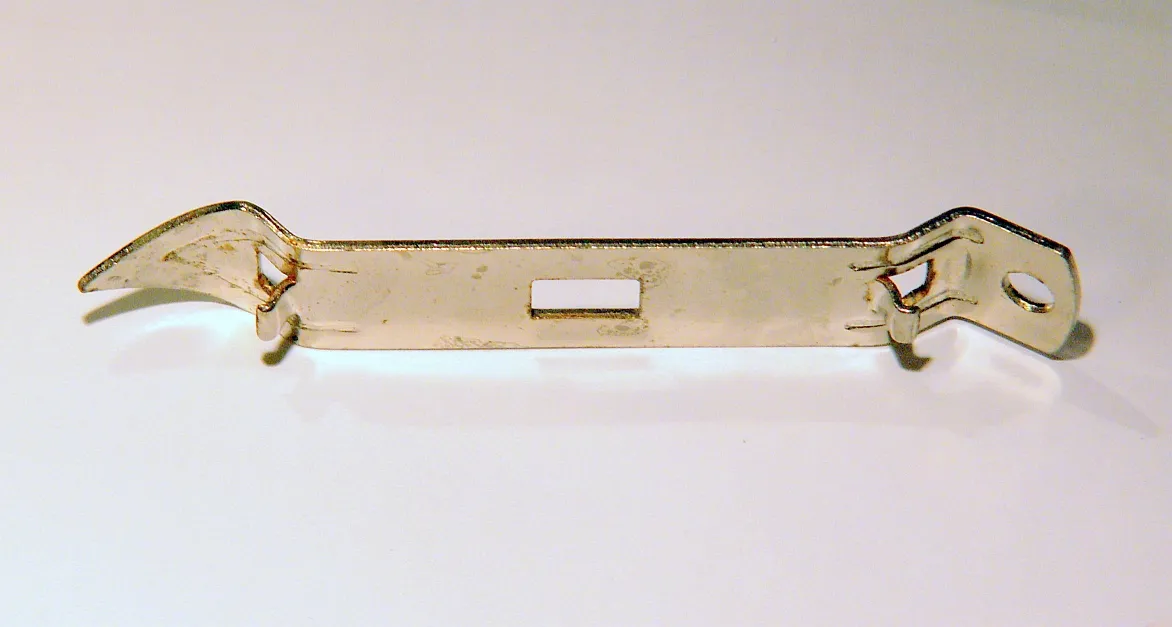
Photo: Caltrop / Wikimedia Commons (public domain)
"Church key" is a North American term, also used in the UK, for several kinds of bottle and can openers. Written use only goes back to the 1950s, and the most common explanation is that the ends of some openers look like the heads of large old keys, the kind used on church doors. When flat-top beer cans arrived in 1935, the same name moved to a one-piece pressed-metal tool with a pointed end for piercing the lid (Wikipedia, Church key). The double-ended version above does both jobs: cap lifter on one end, can piercer on the other.
Best for: anyone who likes a classic tool that still has two uses.
3. The speed opener (bar blade)
A speed opener is a flat steel blade about 4 cm (1.6 in) wide and 16 cm (6.3 in) long, with a thumb hole at one end and a letterbox cut at the other. It also goes by "popper", "mamba", "bar key" and, most often, "bar blade", and it is widely used by professional bartenders in the US, Canada and the UK (Wikipedia, Bottle opener). It is flat enough to carry in a pocket, and the thumb hole can lift a bottle out of the ice bucket by the neck.
Best for: a home bar where one person serves a table of guests.
4. The keychain lever opener
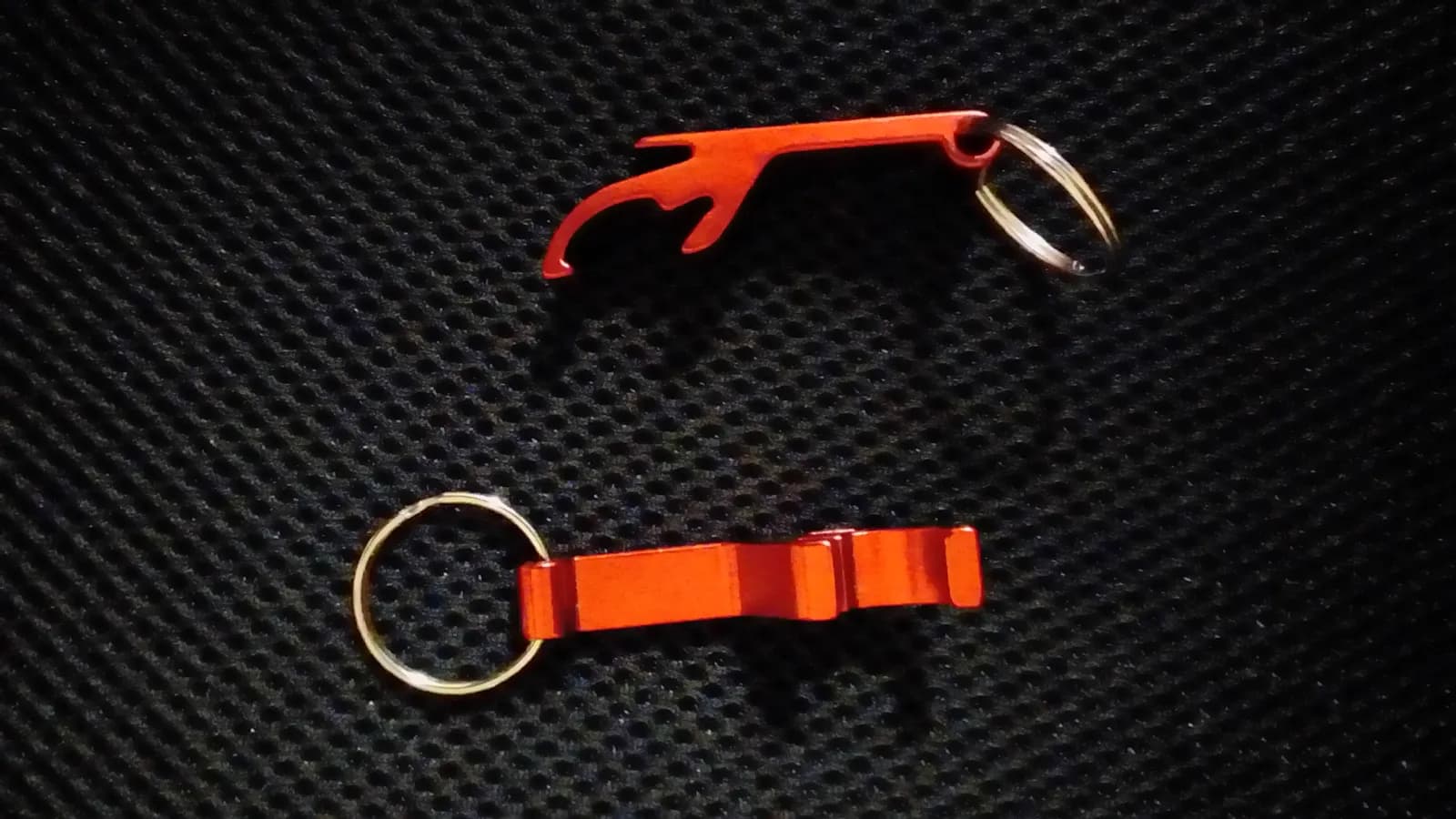
A keychain opener is a short lever with a ring hole, light enough to forget it's there. The photo at the top of this page shows two common shapes: a hook that grabs the cap from the side and a flat, folded bar. Look for a lip that sits firmly under the cap, edges that won't wear holes in a pocket and a handle long enough to open with one push. Our guide to the best keychain bottle opener goes through those checks one by one.
The CapBlast is our version of this type: a slim stainless steel lever opener made for one-hand use and sized for a keyring.
Best for: opening bottles away from home, at a barbecue, a campsite or a friend's place.
5. The wall-mounted or counter-mounted opener
A mounted opener is fixed to a table, bar counter or wall so you can open a bottle with one hand, and the cap can drop into a cap catcher below it. They were once common on vending machines that sold bottled soft drinks, and the first US patent for a bottle opener, granted to Alfred L. Bernardin in 1893, was for a table-mounted model (Wikipedia, Bottle opener).
A wall-mounted bottle opener with a cap catcher is the one to look for if you want a tidy bar. The catcher can be a small box, a bin underneath or a magnet strip that holds the caps, so they land in one place instead of under the fridge. Two things to check before you buy: the screws that come with it should suit your wall (wood, drywall or tile), and the opener should sit at a height where you can hold the bottle straight. Because the opener stays still and you only steady the bottle, mounted models are also one of the most comfortable options for people with sore hands; our guide to easy bottle openers for a weak grip compares them with handheld types.
Best for: a home bar, a garage fridge, a patio or a man cave.
6. The waiter's friend (sommelier knife)
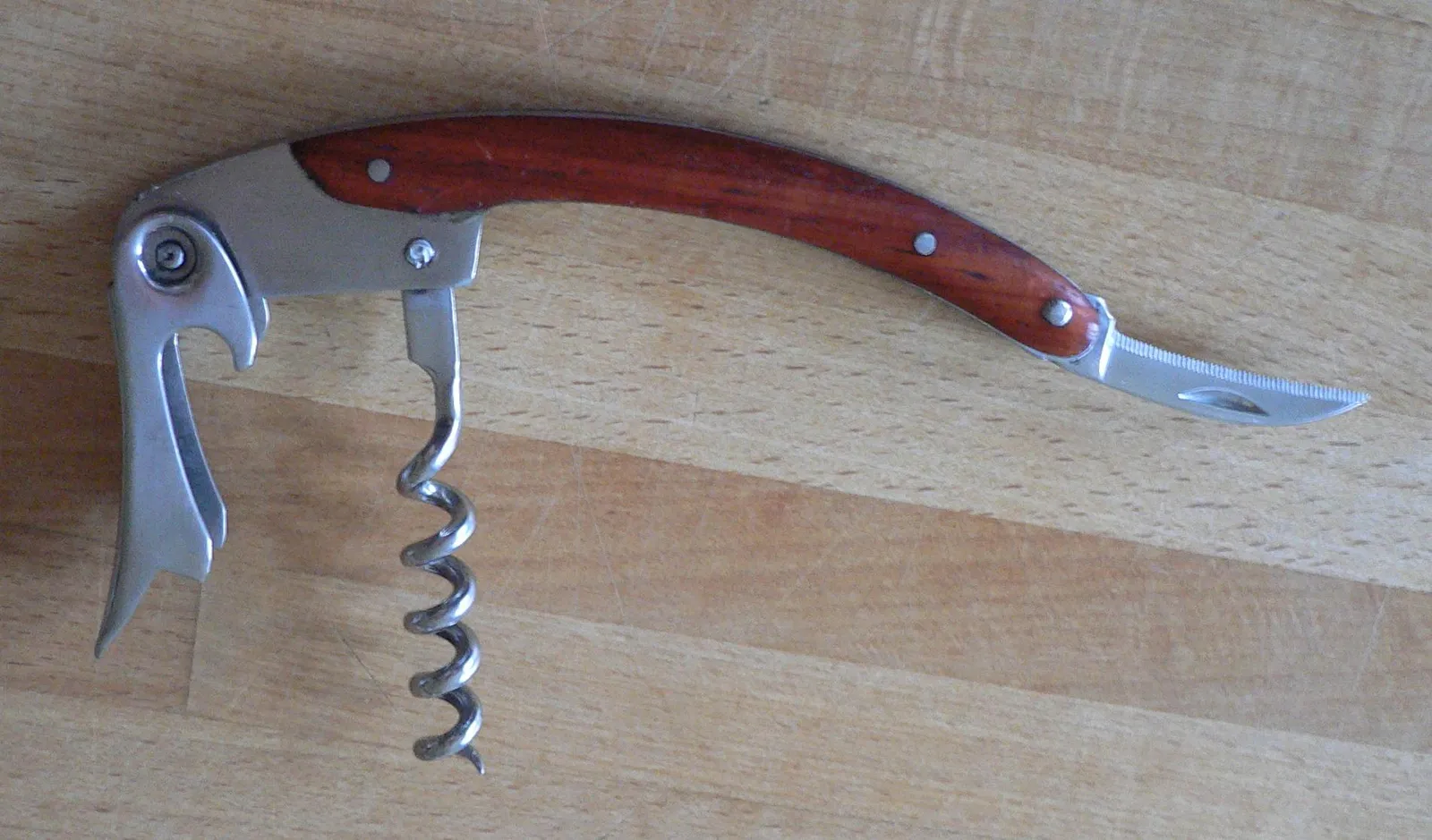
Photo: Georg Slickers / Wikimedia Commons (CC BY-SA 4.0)
The waiter's friend, also called a sommelier knife or wine key, is a corkscrew in a folding body like a pocket knife. It was conceived by the German Karl Wienke in 1882. An arm braces against the lip of the bottle for leverage when you pull the cork, many models have a two-step lever and a bottle opener, and a small folding blade cuts the foil (Wikipedia, Corkscrew). In the photo above, the cap lifter is the hooked notch on the lever arm, just under the hinge.
Best for: households that open wine and beer, and anyone who wants one tool in the drawer instead of two.
7. The multi-opener
Multi-openers, sometimes sold as beverage openers, combine a simple cap lifter with other openers, for example for plastic bottle caps or metal beverage cans (Wikipedia, Bottle opener). Pocket knives and multitools often include a cap lifter too. They save space, but a cap lifter squeezed into a bigger tool usually has a shorter handle, so it takes a little more force than a dedicated opener.
Best for: camping kits, travel bags and toolboxes.
8. The push-down (one-handed) opener
A push-down opener sits on top of the cap. You press down with your palm and the opener lifts the cap off, and some models hold the cap with a magnet so it doesn't fall. There's no hooking and no wrist twist, which is why these openers suit people who find a classic lever awkward. Check that the model fits standard crown caps and that the pressing surface is wide enough for your palm.
Best for: one-handed use and weaker grips.
9. The cap launcher
A cap launcher is a push-down opener with a spring inside. The Beer Mortar is shaped like a small cannon: you set it on a crown cap, point it up and give it one palm strike, and a spring and piston pop the cap off and send it flying upward in the same motion. No batteries, no app. It's the type you choose for fun, not for the kitchen drawer. Our step-by-step guide to what a beer mortar is and how to use it shows the motion, and the physics of a bottle cap trick shot explains where the cap goes and why.
Use it in a clear space, ideally outdoors or under a high ceiling, aim it straight up, and never toward people, pets, faces, lights or anything breakable. The crimped edge of a cap is sharp, so nobody leans over the bottle to watch. It doesn't work on screw caps or swing-top bottles.
Best for: adults who want a bar-top party trick that works on soda and alcohol-free beer as well as beer.
Types of bottle openers compared
| Type | How you use it | Lever action | Where it lives | Best for |
|---|---|---|---|---|
| Hand-held flat opener | Hook and pull up | Class II | Kitchen drawer | Everyday use |
| Church key | Hook and pull up; pointed end pierces cans | Class II | Drawer or bar | Bottles and cans |
| Speed opener (bar blade) | Pull up, or push down | Class II or Class I | Back pocket | Serving guests |
| Keychain lever | Hook and pull up, one hand | Class II | Keyring | Away from home |
| Wall-mounted with cap catcher | Hook the cap, tilt the bottle down | Fixed fulcrum | Wall or counter | Home bar, garage fridge |
| Waiter's friend | Cap lifter on the lever arm | Class II | Drawer or apron | Wine and beer |
| Multi-opener | Depends on the tool | Class II | Toolbox, camping kit | Travel |
| Push-down opener | Press down with the palm | Built-in mechanism | Counter | Weak grip, one hand |
| Cap launcher | Set on the cap, one palm strike | Spring and piston | Bar top | A party trick |
If you'd like to see how novelty shapes fit into these categories, our list of funny bottle openers for the home bar shows a dozen of them, and the shop's novelty bottle openers page gathers ours in one place.
Which bottle opener should you own?
A practical setup is two openers: one that stays put and one that travels.
- Where do you open bottles? Always at the same fridge or bar: a wall-mounted opener with a cap catcher. On the move: a keychain lever. In the kitchen: a flat opener or a church key.
- Do you open wine too? Then a waiter's friend with a cap lifter covers both, and it folds into a drawer.
- How strong is your grip? If twisting or pulling hurts, choose a long handle, a mounted opener or a push-down design over a short keychain tool.
And if no opener is within reach, our guide on how to open a beer without a bottle opener covers the methods that work and the ones that chip teeth.
Bottle openers as gifts
A bottle opener makes a small, useful present: a keychain lever for the friend who's always out, a wall-mounted opener with a cap catcher for someone setting up a home bar, a cap launcher for the one who hosts. Our gifts for beer lovers page has more ideas. Openers work on soda and alcohol-free bottles too, and drinks containing alcohol are for adults who are 21 or older in the US (23 U.S.C. 158) or 18 or older in the UK (GOV.UK). For tips on keeping drinking moderate, see NIAAA's Rethinking Drinking or the UK charity Drinkaware.
The bottom line
The main types of bottle openers are the hand-held flat opener, the church key, the bar blade, the keychain lever, the wall-mounted opener with a cap catcher, the waiter's friend, the multi-opener, the push-down opener and the cap launcher. Nearly all of them are Class II levers with a lip and a fulcrum; what changes is where they live and how much your hand has to do. Pick one for where you open bottles most, add a second for when you're out, and if you want one that people talk about, look at the cap launcher. The CapBlast keychain lever and the Beer Mortar are both in our shop, with free shipping.